The Death of the App: Why the "Intent Canvas" is the Endgame of Operating Systems
We carry supercomputers in our pockets, yet we still interact with them like 1990s filing cabinets.
For more than a decade, the smartphone paradigm has barely moved. You stare at a grid of isolated icons called Apps. To achieve one simple goal, you become a manual router for your own intent: find the right app, open it, translate your desire into its buttons and tabs, then jump to another silo when the next part of the task begins.
This friction is no longer merely annoying. In the age of Large Language Models (LLMs), it feels structurally absurd. Human intent is continuous; the interface is still fragmented.
That is why we are approaching the “Zero-App” era. The future operating system will not be a collection of apps. It will be a singular, ephemeral Intent-Driven Canvas. You speak a command (“I need to go to the airport”), and the OS materializes a hyper-personalized, context-aware interface for that exact moment. When the task ends, the interface dissolves like a ripple on water.
But this cannot work if every interaction depends on an LLM awkwardly writing raw frontend code on demand. That path is too slow, too expensive, and too unstable for an operating system. To make the experience feel instant, the architecture has to change.
The missing layer is the Async Multi-Agent UI Weight Engine.
This is the blueprint for a deeper shift in human-computer interaction: from navigating apps to orchestrating intent.
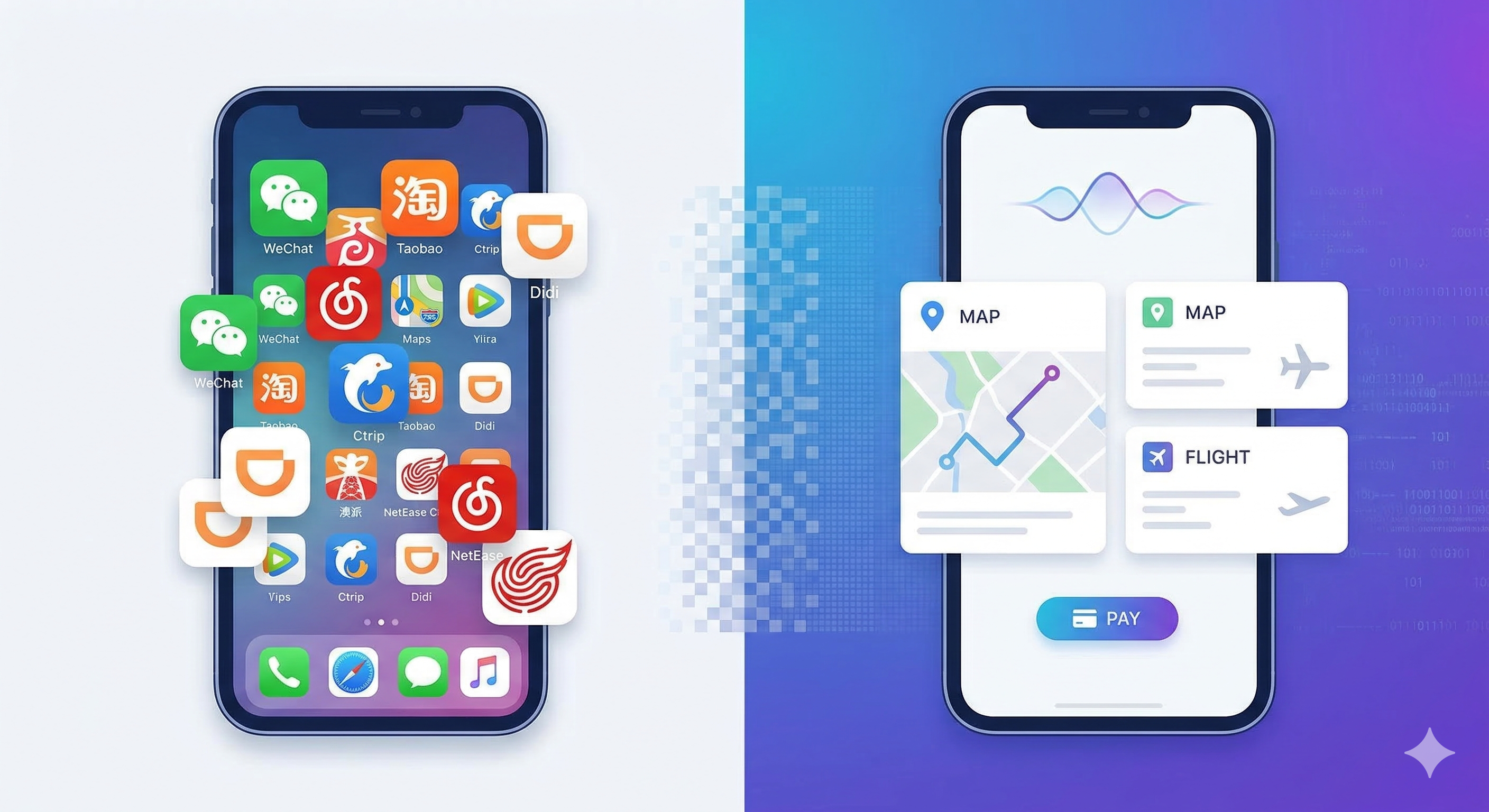 Concept image generated by Nano Banana 2
1. The Core Engine: Assembly Over Synthesis
The fatal flaw of early “Generative UI” was treating AI like a junior developer, asking it to write React or HTML from scratch for every prompt. That approach is a dead end for system-level interaction: it is computationally expensive, slow to render, and prone to visual hallucinations.
The Intent OS does not write interfaces; it assembles them.
Imagine a globally standardized, pre-rendered library of atomic UI components: a digital Lego set containing elements like [Flight_Tracker], [Interactive_Map], or [Checkout_Slider]. The AI’s role shifts from code writer to architect. It selects, ranks, combines, and dismisses components based on what the user is trying to do right now.
When you express an intent, the OS triggers a decentralized swarm of Async Multi-Agents. Fetching your calendar, querying live traffic, and pulling up your Spotify preferences have no strict linear dependency, so those agents can work in parallel. Each returns not just data, but a candidate component for the Canvas.
The key shift is simple: UI becomes a set of callable capabilities, not a page invented from scratch.
2. The Orchestrator: A High-Frequency Trading Floor for UI
Once multiple agents return at the same time, the hard problem is no longer generation. It is order.
Which component gets the center of the screen? Which one becomes a compact notification? Which one disappears because it is useful but not urgent? The answer is that agents do not draw directly. They bid.
The Orchestrator (The Broker): It receives your multimodal intent (“Airport, now”) and wakes up the relevant specialized agents.
The Multi-Agent Weight Engine (The Auction): Agents operate like algorithms on a high-frequency trading floor, bidding for screen real estate based on contextual urgency.
- The Calendar Agent realizes your flight boards in 45 minutes. It grabs the [Boarding_Pass_Component] and slams down a Weight of 9.9.
- The Transit Agent detects a major highway crash. It grabs the [Alternative_Route_Map] and bids a Weight of 9.5.
- The Music Agent fetches a [Driving_Playlist] but, sensing the urgency, only bids a Weight of 3.0.
Instant Resolution: In milliseconds, the Orchestrator runs a spatial packing algorithm. The highest-weight components dominate the Canvas. Lower-weight components are folded, delayed, or hidden. A bespoke, functional interface appears faster than a human can blink.
This is the operating system as a real-time allocator of attention. It no longer asks every service to fight for its own app icon. It asks every service to contribute the right interface fragment to the user’s current intent.
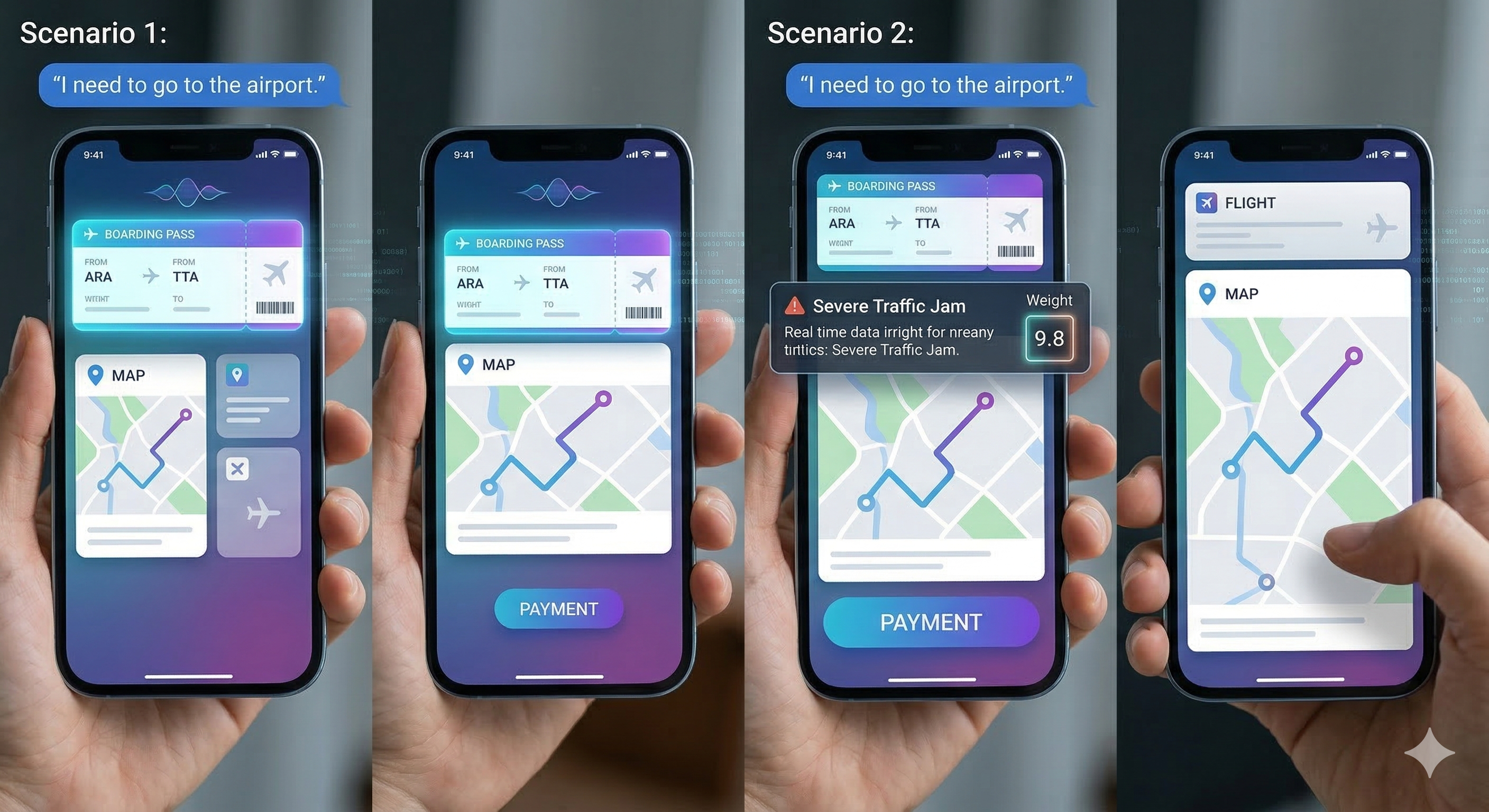 Concept image generated by Nano Banana 2
3. The Real Barriers Are Behavioral, Economic, and Political
A vision this disruptive threatens existing business empires, UX norms, and privacy expectations. The technical demo is the easy part. The harder question is whether the system can resolve four deeper tensions.
Cognitive Load -> The Chameleon UI
The Friction: Human muscle memory relies on spatial consistency. If an OS dynamically shifts the UI layout every time you unlock your phone, users will experience severe cognitive whiplash.
The Breakthrough: The Intent OS maps your “UI DNA.” If the system observes that you spend 80% of your digital life inside WeChat or iMessage, the generated Canvas can adopt that app’s spatial logic: bottom navigation, high-contrast lists, familiar hierarchy. It does not force users to relearn every screen. It adapts to the patterns already embedded in their muscle memory.
Every dynamic interface should feel strangely familiar. That is the Chameleon UI.
The App Store -> The Intent Economy
The Friction: Why would tech titans like Uber, Airbnb, or Yelp allow their beautifully walled gardens to be dissolved into “Headless APIs” for an OS to cannibalize?
The Breakthrough: Because the Attention Economy is giving way to the Intent Economy. Companies currently burn billions on user acquisition just to get an app installed and reopened. In the Intent OS, they provide high-performance APIs to the OS Orchestrator. When the OS selects Uber’s API to fulfill a user’s transit intent, a micro-transaction dividend is routed to Uber via a smart contract.
Brands will no longer compete primarily for screen time. They will compete to be the most reliable service at the moment of intent.
Generation’s Boundary -> The Eradication of Tools
The Friction: Can an Agent really replace complex software like Premiere Pro, Blender, or a AAA video game?
The Breakthrough: We need a hard line between Tools and Immersion. The Intent OS will first attack Task-based Tools. Software like video editors or spreadsheets are complex translation layers between human desire and machine execution. When an Agent can execute “edit this footage into a cyberpunk montage,” much of the timeline UI becomes unnecessary.
Immersion is different. Gaming, VR, interactive art, and deep reading are not merely paths to a result; they are the result. The Zero-App philosophy clears mundane utility apps off the device and reserves more of the hardware’s bandwidth for uninterrupted immersive experiences.
Privacy -> Digital Sovereignty
The Friction: For the Orchestrator to perfectly anticipate your needs, it requires an omniscient, terrifying level of context: your live location, heart rate, bank balances, and private whispers. Sending this to a corporate cloud is a dystopian nightmare.
The Breakthrough: The Intent OS depends on the rise of the Personal AI Supercomputer. In this future, the cloud is reserved for generic public data. Every user hosts a sovereign AI node, either through a massive NPU on the device or a dedicated AI server in the home.
Your omniscient context never leaves your physical possession. The local model processes your intent, anonymizes it, and sends only strictly sanitized API requests into the world. The promise is complete personalization without surrendering the full map of your life.
The Canvas Awaits
The App era will not vanish overnight, but its center of gravity is shifting.
The transition to the Intent-Driven Canvas is not just a UI overhaul. It is a realignment of distribution, service invocation, and human-computer interaction. In the old model, users organize their behavior around apps. In the new model, services reorganize themselves around user intent.
Async Multi-Agent architectures provide the mechanism: parallel agents gather context, a weight engine allocates screen space, atomic components assemble the interface, and localized digital sovereignty protects the user’s private context.
What changes is not just the number of icons on the home screen. What changes is the direction of adaptation. Instead of humans learning the logic of machines, machines begin adapting to the shape of human intent.
The apps are fading. Long live the Canvas.
引用
若想引用本文,请使用:
@misc{dong2026deathoftheapp,
  author = {Peijie Dong},
  title = {The Death of the App: Why the "Intent Canvas" is the Endgame of Operating Systems},
  year = {2026},
  month = mar,
  day = {18},
  howpublished = {\url{https://pprp.github.io/tech/death-of-the-app-en/}},
  url = {https://pprp.github.io/tech/death-of-the-app-en/},
  note = {Blog post. Accessed: 2026-04-28},
  language = {English}
}