The Death of the App: Why the "Intent Canvas" is the Endgame of Operating Systems
We are carrying quantum-leap supercomputers in our pockets, yet we interact with them like 1990s filing cabinets.
For over a decade, the smartphone paradigm has been frozen. You stare at a grid of isolated icons—the “Apps.” To achieve a single goal, you must become a manual laborer in the digital realm: hunting for the right app, opening it, translating your human desire into its specific button layout, and jumping between silos to get things done.
This friction is no longer just annoying; in the age of omniscient Large Language Models (LLMs), it is fundamentally absurd.
We are standing at the precipice of the “Zero-App” era. The future operating system will not be a collection of apps. It will be a singular, ephemeral Intent-Driven Canvas. You speak a command (“I need to go to the airport”), and the OS instantly materializes a hyper-personalized, context-aware interface designed exclusively for that exact moment. Once the task is done, the interface dissolves like a ripple on water.
But to achieve this seamlessly—not in agonizing seconds, but in imperceptible milliseconds—we cannot rely on LLMs awkwardly writing raw frontend code on the fly. We need a radical architectural leap: The Async Multi-Agent UI Weight Engine.
Here is the blueprint for the ultimate revolution in human-computer interaction.
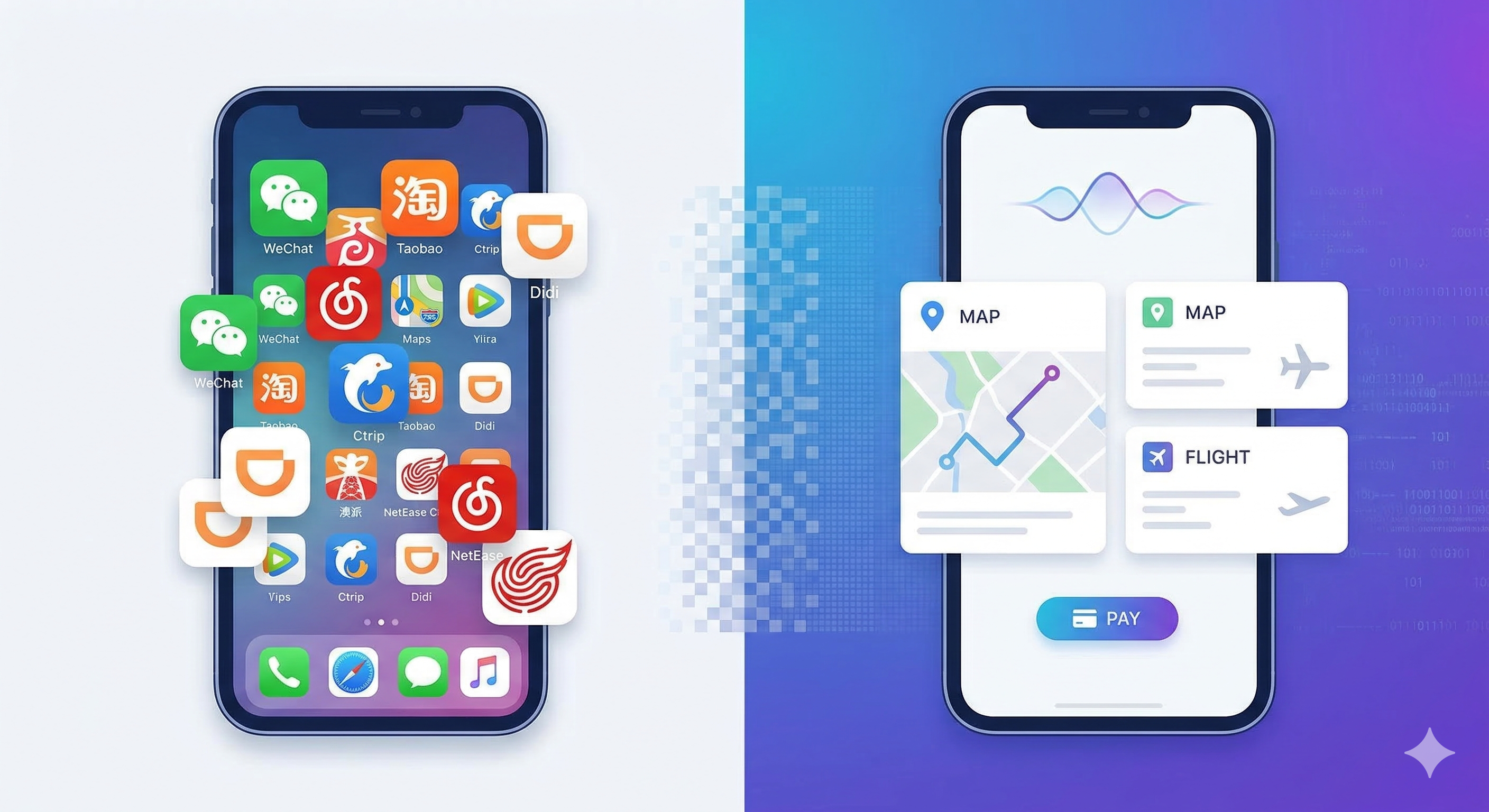 Concept image generated by Nano Banana 2
1. The Core Engine: Symphony Over Synthesis
The fatal flaw of early “Generative UI” was treating the AI like a junior developer, forcing it to write React or HTML from scratch for every prompt. This is a dead end: it’s computationally expensive, agonizingly slow, and prone to visual hallucinations.
The Intent OS does not write interfaces; it assembles them.
Imagine a globally standardized, pre-rendered library of atomic UI components—a limitless digital Lego set containing elements like [Flight_Tracker], [Interactive_Map], or [Checkout_Slider]. The AI’s role shifts from a code-monkey to a Master Architect.
When you express an intent, the OS triggers a decentralized swarm of Async Multi-Agents. Because fetching your calendar, querying live traffic, and pulling up your Spotify preferences have no linear dependencies, these agents execute their missions entirely in parallel.
2. The Orchestrator: A High-Frequency Trading Floor for UI
How do multiple independent agents build a cohesive screen without causing visual chaos? They don’t draw; they bid.
The Orchestrator (The Broker): It receives your multimodal intent (“Airport, now”) and wakes up the relevant specialized agents.
The Multi-Agent Weight Engine (The Auction): Agents operate like algorithms on a high-frequency trading floor, bidding for screen real estate based on contextual urgency.
- The Calendar Agent realizes your flight boards in 45 minutes. It grabs the [Boarding_Pass_Component] and slams down a Weight of 9.9.
- The Transit Agent detects a major highway crash. It grabs the [Alternative_Route_Map] and bids a Weight of 9.5.
- The Music Agent fetches a [Driving_Playlist] but, sensing the urgency, only bids a Weight of 3.0.
Instant Resolution: In milliseconds, the Orchestrator runs a spatial packing algorithm. The highest-weight components dominate the top of the Canvas. A bespoke, highly functional interface is born faster than a human can blink.
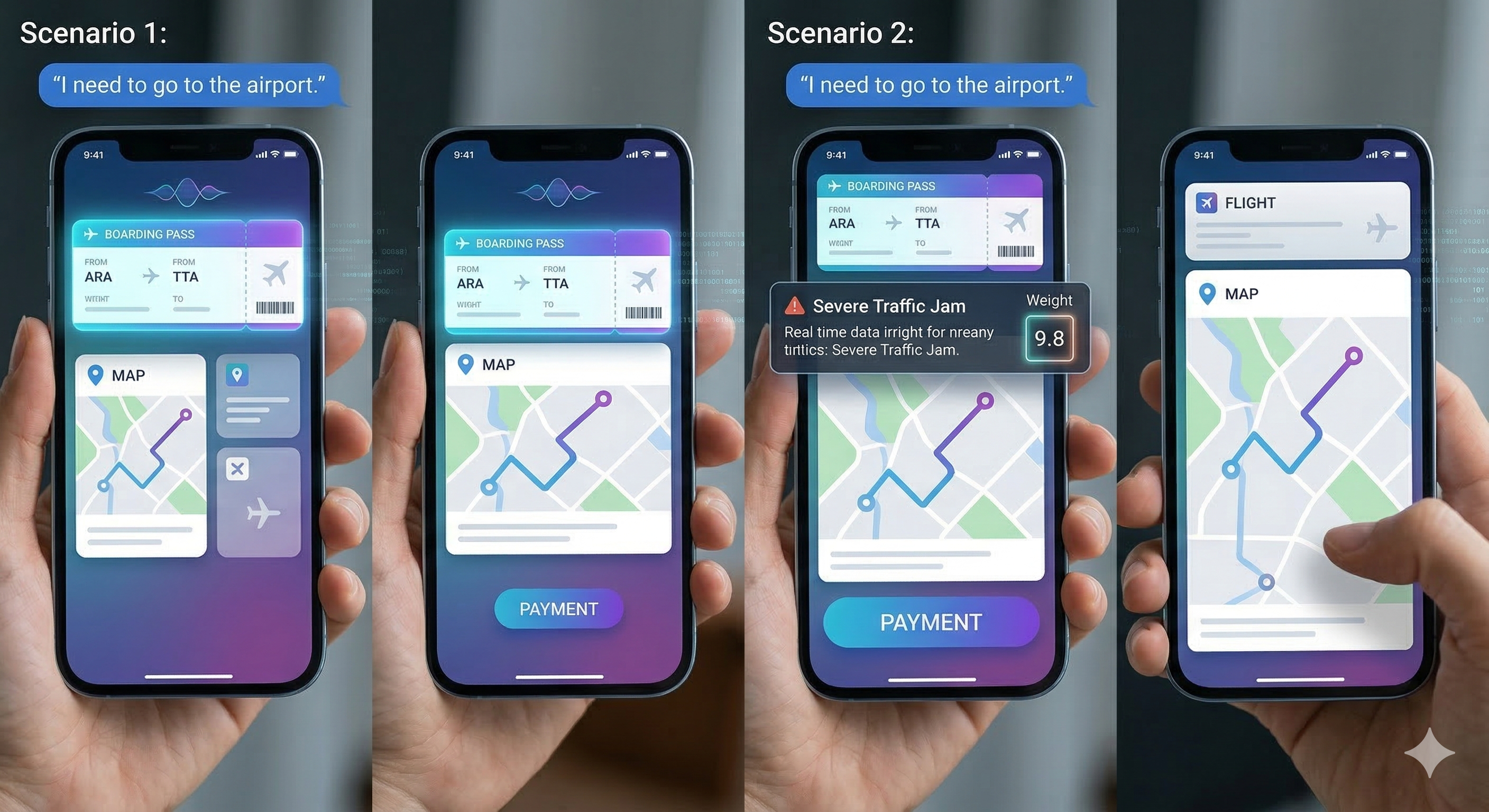 Concept image generated by Nano Banana 2
3. Shattering the Reality Distortion Field
A vision this disruptive threatens existing business empires, UX norms, and privacy standards. The Intent OS doesn’t just bypass these hurdles; it leverages them to redefine the ecosystem.
The Cognitive Load Crisis -> Enter the “Chameleon UI”
The Friction: Human muscle memory relies on spatial consistency. If an OS dynamically shifts the UI layout every time you unlock your phone, users will experience severe cognitive whiplash.
The Breakthrough: The Intent OS maps your “UI DNA.” If the system observes that you spend 80% of your digital life inside WeChat or iMessage, the generated Canvas will inherently adopt that app’s spatial logic—perhaps placing vital navigation at the bottom and using high-contrast list views. It merges with your existing muscle memory. Every dynamically generated interface feels instantly familiar. We call this the Chameleon UI.
The Death of the App Store -> The “Intent Economy”
The Friction: Why would tech titans like Uber, Airbnb, or Yelp allow their beautifully walled gardens to be dissolved into “Headless APIs” for an OS to cannibalize?
The Breakthrough: Because the Attention Economy is dying, and the Intent Economy is taking its place. Companies currently burn billions on user acquisition just to get an app installed. In the Intent OS, they provide pure, high-performance APIs to the OS Orchestrator. When the OS selects Uber’s API to fulfill a user’s transit intent, a micro-transaction dividend is instantly routed to Uber via a smart contract. Brands will no longer compete for screen time; they will compete on pure utility.
The Boundary of Generation -> The Eradication of Tools
The Friction: Can an Agent really replace complex software like Premiere Pro, Blender, or a AAA video game?
The Breakthrough: We must draw a hard line between Tools and Immersion. The Intent OS will mercilessly eradicate Task-based Tools. Software like video editors or spreadsheets are merely complex translation layers between human desire and machine execution. When an Agent can flawlessly execute “edit this footage into a cyberpunk montage,” the timeline UI becomes obsolete.
However, Immersion (gaming, VR, interactive art) is the destination itself. The Zero-App philosophy clears the mundane utility apps off your device, dedicating your hardware’s maximum bandwidth to pure, uninterrupted immersive experiences.
The Privacy Paradox -> The Era of Digital Sovereignty
The Friction: For the Orchestrator to perfectly anticipate your needs, it requires an omniscient, terrifying level of context: your live location, heart rate, bank balances, and private whispers. Sending this to a corporate cloud is a dystopian nightmare.
The Breakthrough: The Intent OS is inextricably linked to the rise of the Personal AI Supercomputer. In this future, the “cloud” is reserved for generic public data. Every user will host a sovereign AI node—either a massive NPU on the device or a dedicated AI server in their living room. Your omniscient context never leaves your physical possession. The local mega-model processes your intent, anonymizes it, and sends only strictly sanitized API requests out into the world. Complete hyper-personalization, zero privacy compromise.
The Canvas Awaits
We are witnessing the death rattle of the App era.
The transition to the Intent-Driven Canvas is not just a UI overhaul; it is the most profound realignment of human-computer interaction since the invention of the mouse. By wielding Async Multi-Agent architectures as real-time UI weight engines, and anchoring them in localized digital sovereignty, we are finally building technology that stops demanding our navigation, and simply answers our intent.
The apps are dead. Long live the Canvas.